Kep Salt Fields
A working landscape of seawater and salt production
Explore this place
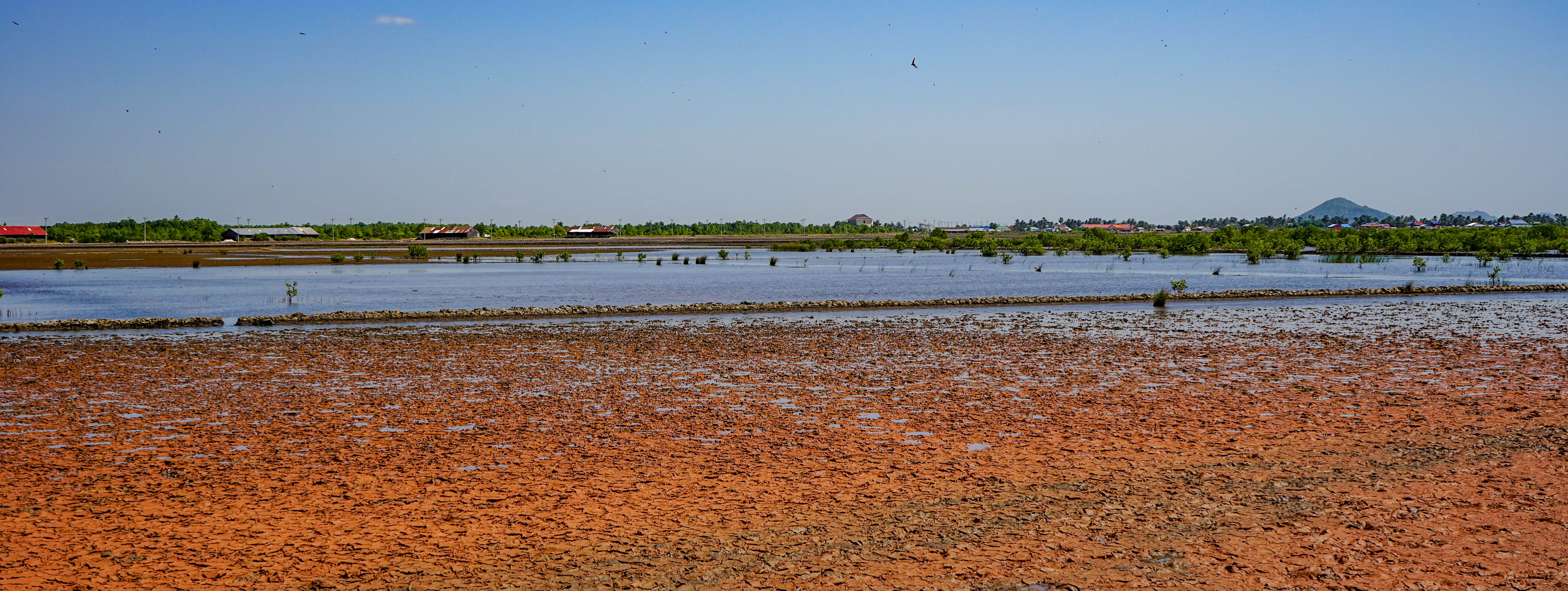
Shallow salt pans on Kep’s coastal plain form a geometric landscape of water, earthen ridges and seasonal work. These are productive fields, not a single ticketed theme park.
Visit tips
Observe water levels, evaporating pans and repeated earthen geometry from the edge.
What to look for
- Observe the rectangular evaporation pans from public access points.
- Look for changes between water-filled, drying and harvested pans.
- Respect workers and never enter production areas without permission.
About this place and who manages it
These are active salt-production areas operated by local producers, not one publicly administered attraction with a universal entrance. Access to working pans requires the operator’s permission.
Salt production is part of Cambodia’s southern coastal economy. Sea water evaporates in managed pans, connecting local labour, climate and food supply.
Visitor essentials
- Location
- Salt-production areas, Kep Province, Cambodia; multiple fields, no single entrance
- Attraction type
- Working salt-production landscape
- Management
- These are active salt-production areas operated by local producers, not one publicly administered attraction with a universal entrance. Access to working pans requires the operator’s permission.
- Visiting time
- 30–90 minutes
- Google rating
- No independently verified current rating
Opening hours
Working hours and access vary by field and season; there is no single visitor timetable.
Tickets and prices
No single park ticket. Any guided visit requires permission and a directly agreed price.
Getting there
Choose a specific public roadside viewpoint in the Kep salt-field area. Arrange local transport rather than entering production tracks uninvited.
Salt fields are spread across Kep Province; select a specific public roadside viewpoint and avoid navigating to a random field interior. Dry-season production varies with weather.
Open this place in Google MapsWhat to look for
- Observe the rectangular evaporation pans from public access points.
- Look for changes between water-filled, drying and harvested pans.
- Respect workers and never enter production areas without permission.
Landscape and built features
Low earthen ridges divide the pans into precise rectangles. Water surfaces, drying beds and shelters show how simple engineering uses sun and wind.
Cultural context
Salt making links coastal climate, local labour and food preservation.
The core experience
Observe water levels, evaporating pans and repeated earthen geometry from the edge.
Suggested walking route
- Choose a publicly accessible roadside viewing point.
- Observe the evaporation pans and working areas without crossing barriers.
- Continue to a second safe viewpoint only if roads and operators allow it.
Visiting tips
- Do not walk on salt pans.
- Ask permission before photographing workers.
- Bring shade and water; the plain can be exposed.
Photography advice
The repeating salt-pan geometry and reflections work well in low light; photograph workers only with consent.
Where to stay
Kep town provides a practical base for countryside stops and the Crab Market.
Visitor feedback
Because the fields are separate workplaces, individual map reviews may refer to different locations; use recent photos and local guidance.
View current reviewsFrequently asked questions
Can I walk onto the salt pans?
These are workplaces. Do not enter without operator permission.
Is salt harvested all year?
Production depends on the dry season and weather; check locally.
More places around Kep
Address and map
Salt-production areas, Kep Province, Cambodia; multiple fields, no single entrance
Choose a specific public roadside viewpoint in the Kep salt-field area. Arrange local transport rather than entering production tracks uninvited.
📍 Open this place in Google MapsSources and checks
Information checked 16 November 2026. Confirm current access, prices and transport locally.
